





1. Introduction
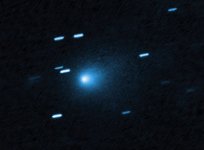
Comet 3I/ATLAS, officially designated C/2025 N1, is the third known interstellar object to enter our Solar System. Discovered on July 1, 2025, by the ATLAS telescope in Chile, it has drawn worldwide attention for its unusual activity and composition. Despite public concern, NASA has confirmed it poses no threat to Earth.
2. Discovery and Designation
The name 3I/ATLAS denotes it as the third interstellar (I) object identified, discovered by the Asteroid Terrestrial-impact Last Alert System (ATLAS). Its hyperbolic trajectory indicates it originated outside the Solar System. At closest approach, it will pass approximately 1.8 AU from Earth—well beyond any danger zone.
3. Physical & Compositional Characteristics
The nucleus of 3I/ATLAS is estimated between 0.5 and 5.6 kilometers in diameter. Despite its great distance from the Sun, it has shown unexpected levels of activity. Spectroscopic data reveal a CO₂-to-H₂O ratio around 8:1, among the highest ever recorded. Scientists believe prolonged exposure to cosmic rays during its interstellar journey altered its surface chemistry.
4. Scientific Observations
Major telescopes such as JWST, Hubble, and Gemini North have observed 3I/ATLAS. Ultraviolet data detected hydroxyl emission when it was still 3.5 AU from the Sun, indicating strong water outgassing (~40 kg/s). Polarimetric data revealed unusual light scattering, suggesting distinctive dust or ice properties.
5. Public Concern & Media Interest
News of an interstellar comet often fuels public speculation about potential risks. While 3I/ATLAS is completely harmless, its unpredictable behavior and interstellar origin have sparked intrigue. NASA and the scientific community emphasize that its study represents a rare opportunity to analyze material from beyond our Solar System.
6. Scientific Importance
3I/ATLAS provides crucial data about planetary formation beyond our system. Its composition challenges models of comet chemistry and demonstrates how interstellar radiation can reshape icy bodies over millions of years. By comparing it to 1I/ʻOumuamua and 2I/Borisov, scientists are expanding their understanding of interstellar material diversity.
7. Observation Timeline
Date (2025) | Event | Notes |
July 1 | Discovery | ATLAS telescope, Chile |
July–Aug | Water activity detected | ~40 kg/s outgassing |
Oct 29 | Perihelion | 1.4 AU from Sun |
Dec onward | Post-perihelion observations | Re-emerges from behind the Sun |
8. Key Facts Table
Property | Value | Source |
Diameter | 0.5–5.6 km | NASA |
Closest to Earth | 1.8 AU | NASA |
CO₂/H₂O ratio | 8:1 | JWST |
Water output | 40 kg/s | Space.com |
9. Future Research
Future observations aim to monitor the comet’s post-perihelion evolution. Spectroscopy will search for organic compounds, while photometry will measure its fading activity. Comparing this data to previous interstellar visitors could reveal patterns in how such bodies form and evolve in deep space.
10. Conclusion
3I/ATLAS is not a threat but a scientific gift. As a rare interstellar visitor, it offers invaluable data about the composition of distant star systems and the processes that shape comets across galaxies. Continued observation and analysis may uncover new insights into cosmic chemistry and the origins of our Solar System.